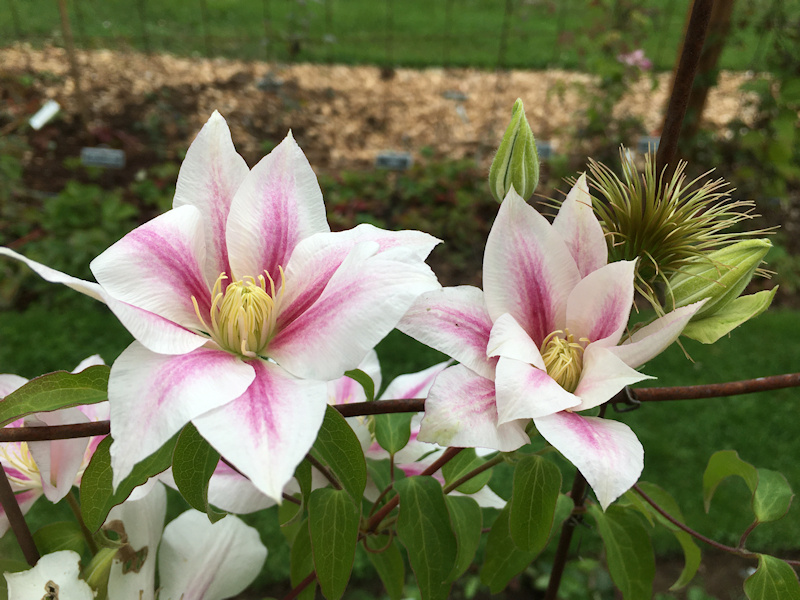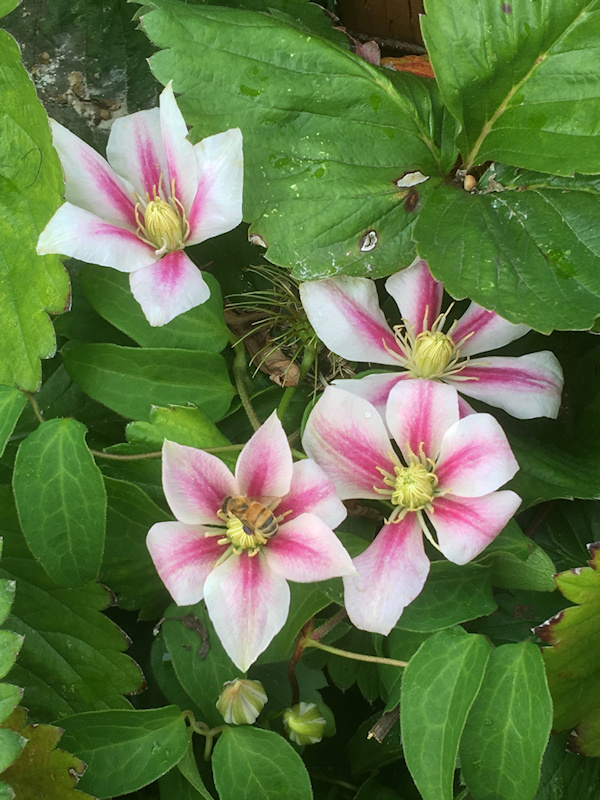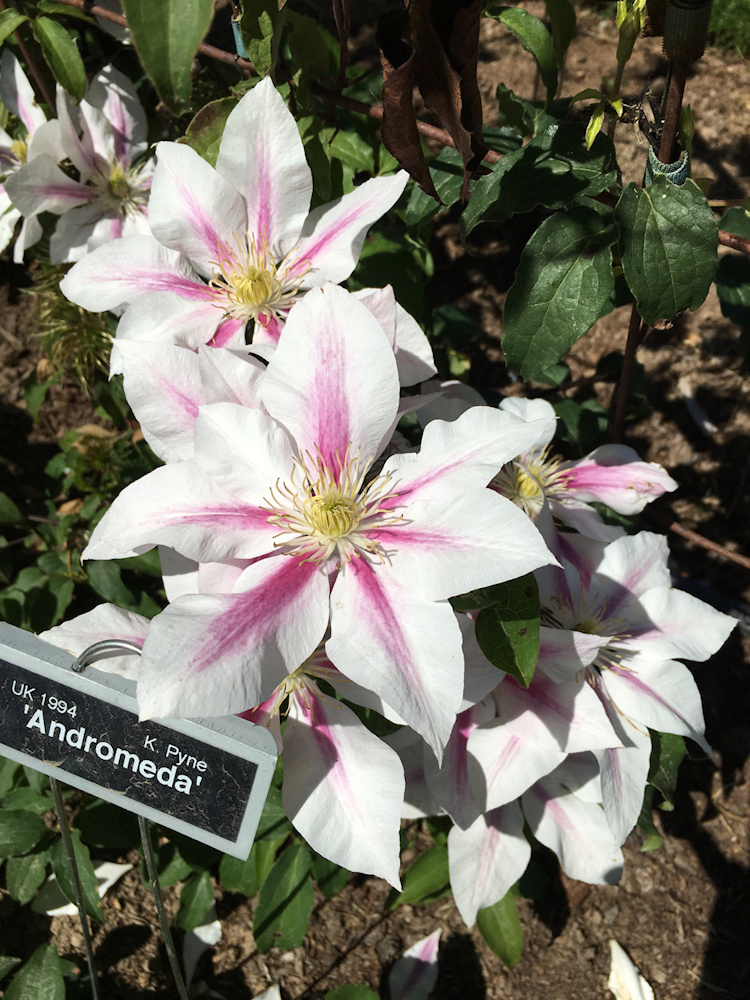
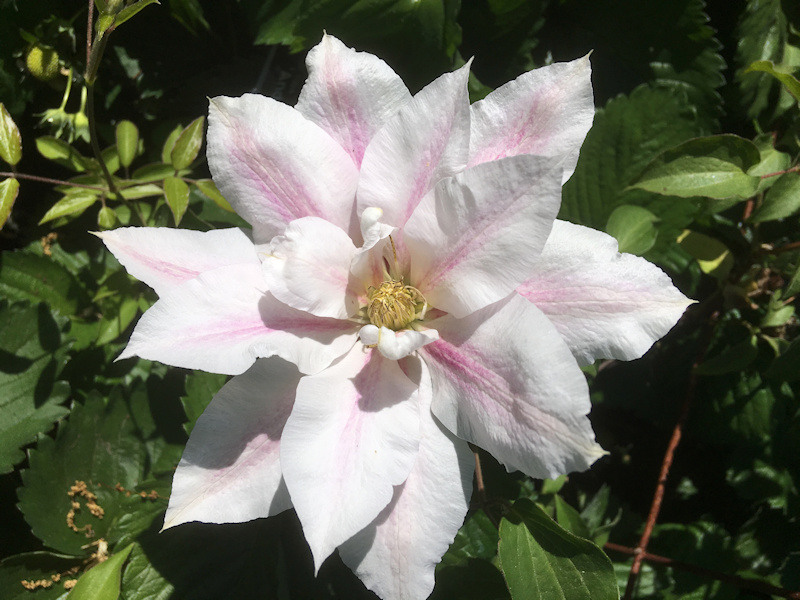
My first glimpse of Clematis 'Andromeda' was not in person, but rather in an advance copy of "An Illustrated Encyclopedia of Clematis" by Mary Toomey and Everett Leeds that was perched on a lectern in the offices of Timber Press in Portland Oregon. It was the summer of 2001, with the book not yet released for sale. Timber Press was hosting a party for the authors, who were in town for the first visit of the International Clematis Society to North America. Pictured was the single version of 'Andromeda'. I think I stopped breathing for a minute. Striped large-flowered clematis aren't for everyone. Their colors have been likened to striped silk pajamas, and not with complimentary intent. They could be seen as excessively, even tastelessly, vivid. C. 'Andromeda' changed my opinion with one look. The tepals are pointed, with a clean red brushstroke of color radiating from under the boss of stamens but not reaching the end of the tepal. Unlike any striped or barred clematis I'd seen before, the background was a clear, clean white. Gone was the insipid pink with a cerise bar. The contrast of something akin to true red on pristine white was intensely pleasing. Plus, the flower was of a starrier profile than is typical for large-flowered hybrids, so I appreciated the name. Sparkling Andromeda, the brightest galaxy in the night sky. I do love apt clematis names. In those days, it was still relatively easy to order clematis from the UK into the US, so in 2004 the Rogerson Clematis Collection teamed with Joy Creek Nursery to place a large enough order with Thorncroft Nursery to make a phytosanitary inspection worth everyone's time. That is how we came to have C. 'Andromeda' in the Collection. In this case, I was not a careful reader. It hadn't sunk in that 'Andromeda' could be double. Imagine my surprise when the first spring flowers of 2005 were, in fact, fluffy and fully layered with sepals. This muddled the effect of the orderly flashes of red. Thus began the surreptitious removal of full round buds likely to produce double flowers. However, once it was planted in the Rogerson Clematis Garden (RCG), new double buds would slip my notice. I've been asked why it wasn't planted in the Modern Garden's Row 8, where many new always-double or spring-double clematis are grown together. A vague answer is offered: it is rarely double (right…because someone trims off the double buds). We divided and took cuttings from that first specimen, and when I got my own, I learned that it grows well in containers. I could easily move mine from place to place until it settled near one of the original Hybrid Musk Roses, 'Robinhood', with a color the same as the brushstroke of C. 'Andromeda'. When those pesky double buds arise, I cut them off at the node and give a healthy dose of fertilizer by way of apology. The single flowers come on 30-45 days later and continue for a good long while. It is reported that C. 'Andromeda' can reach 4m tall, but it has never yet been taller than 2m at the RCG or at my home garden. It stays well-furnished with leaves at the base, and wants to bloom from the ground up, both very good attributes for clematis you ask to cover the woody base of something that gets taller, or grow in a container on a short structure. The pictures provided give an idea of the ease of rebloom. The double flower below was taken in May 2018, as one would expect. The picture at the top of this page was taken in July 2020 and shows the typical first rebloom after the double flowers are spent (or the double buds removed, she said unrepentantly). Of the other two pictures below, that from 2019 shows a third bloom wave amid the strawberry foliage used for groundcover (taken in late August), and the 2021 image was taken in late September, flowering at not quite 2m tall. C. 'Andromeda' taken in July 2020, after the double blooms are spent (or removed!)
Over 20 years later, Ken Pyne's Clematis 'Andromeda' remains unique: starry and light of texture, with fresh cherry red against untainted white in the single form. And in this age of climate change, it should also be reported that the warmer the weather, the deeper the red. PS — This article should not start any rumors that the author dislikes double clematis as a general thing. C. 'Chalcedony' is swoon-worthy. C. 'Duchess of Edinburgh' is a dear friend. C. 'Louise Rowe' is luscious at her double best, and we must mention C. 'Kiri te Kanawa' and C. 'Belle of Taranaki', both absolute delights.
May 2018, showing the double flower
Late September 2021 and flowering at not quite 2m tall
Late August 2019 showing a third bloom wave amid strawberry foliage used for groundcover
Linda Beutler