
C. 'Zo09088' SUPER NOVAPBR
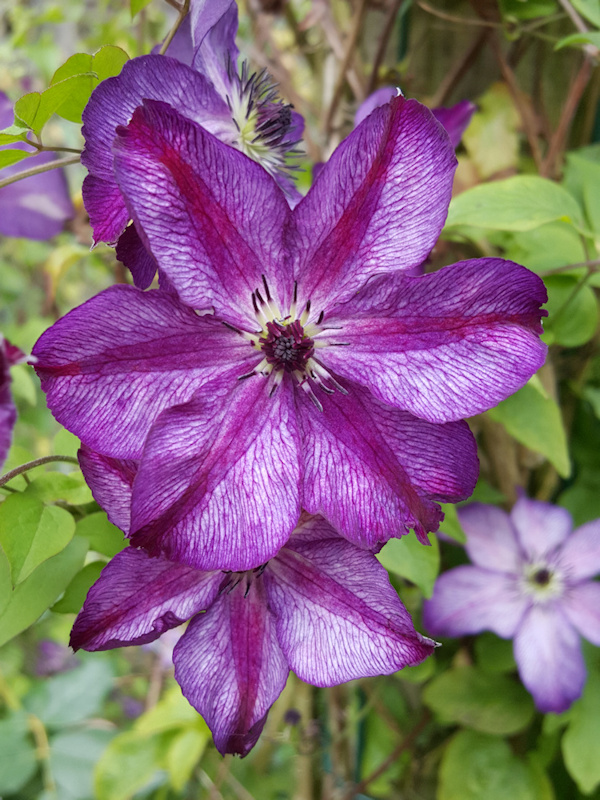 C. 'Zo09088' SUPER NOVAPBR showing |
 C. 'Zo09088' SUPER NOVAPBR showing |
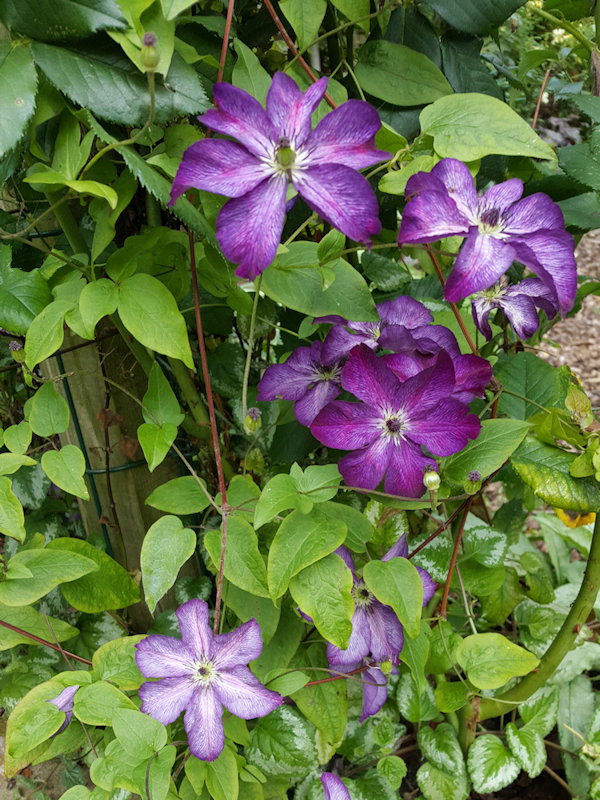 C. 'Zo09088' SUPER NOVAPBR in 2019 |
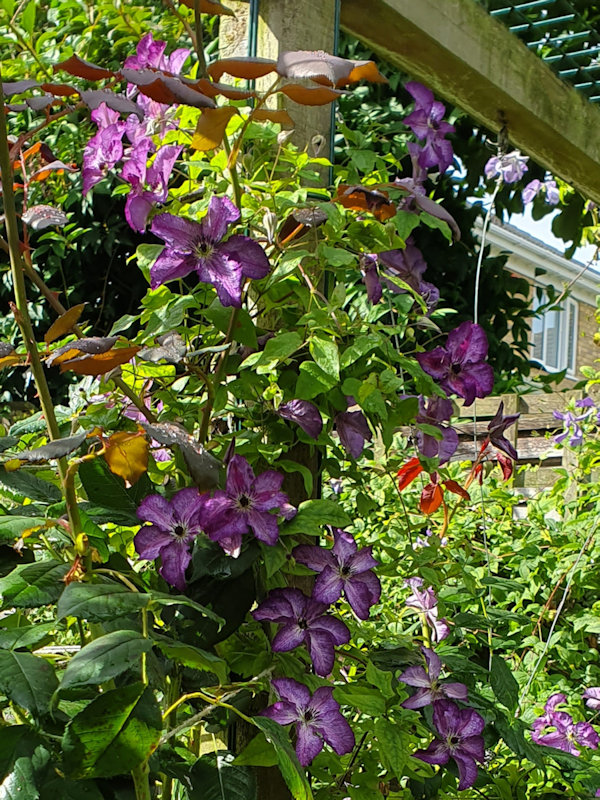 C. 'Zo09088' SUPER NOVAPBR in 2023 |
I have been growing this clematis in my garden now for at least 6 years and every year I am pleased with its reliable performance. I love the dark central boss and the dark veining on the tepals. The flower colour is unusual; it does fade in the sun and looks different in different lights! The top photo was taken at the beginning of August and shows two flowers, the first has a deep reddish coloured central bar the second has a paler bar to the tepal. (Clematis have tepals rather than petals). The flowers are about 5 to 8 cm across, not huge but they have visual impact. It is planted to climb up through a pinky apricot rose and, so far, I do not believe that the clematis and rose have been in flower at the same time. However, that means that the flowering period of the combination of clematis and rose is extended! C. 'Zo09088' SUPER NOVAPBR
I have a number of photos which show a brighter redder flower and then other photos with lighter coloured flowers. The central part of the flower has white filaments and purple anthers which are more obvious when the tepal central bar is paler than darker. Generally, the flowers start darker and then fade as they mature and are exposed to sunlight, as you can see on the photos below. Some years there are darker flowers and lighter flowers together. On a different year the flowers open more together and are much more similar to each other in colouring. That's the beauty of these flowers – you never know from year to year what the colour scheme will be! I did wonder if the darker flowers were more usual on the younger plant, but a close examination of my photos showed darker flowers in photos taken in August 2023.
C. 'Zo09088' SUPER NOVAPBR showing
deep reddish coloured central bar of the tepalC. 'Zo09088' SUPER NOVAPBR showing
paler central bar which shows of the purple anthers wellMany of you may grow Clematis 'Venosa Violacea' (also known as VIOLET STAR GAZER in the USA) which has similar flowers. C. 'Venosa Violacea' usually has paler central tepals and less colour variation. I have seen C. 'Zo09088' SUPER NOVAPBR described as a more compact version of C. 'Venosa Violacea' but I feel that the colour variation and veining of C. 'Zo09088' SUPER NOVAPBR means that it has more to offer in terms of an interesting plant in the garden. C. 'Zo09088' SUPER NOVAPBR is classed by the breeder, Wim Snoeijer, as in the Viticella Group. We have featured previously featured C. 'Venosa Violacea' and one of the queries raised then by the authors, Linda Beutler and Maurice Horn, was regarding the parentage of C. 'Venosa Violacea' in that C. 'Venosa Violacea' does not have the classic nodding buds of a Viticella. C. 'Zo09088' SUPER NOVAPBR does have nodding buds. C. 'Zo09088' SUPER NOVAPBR is said to flower from June to September but because of the amount of shade where it is positioned in my garden it doesn't really start flowering until late July which is why all of my photos were taken in August and September. It is said to be hardy to Zone 6.
C. 'Zo09088' SUPER NOVAPBR in 2019
with light and dark flowersC. 'Zo09088' SUPER NOVAPBR in 2023
with more uniformly coloured flowers backlit by the sun
 Fiona Woolfenden